I hate the term AI. It is an extremely unhelpful umbrella term, loaded with context from science-fiction and vague visions of the future, referring to an unwieldy spectrum of concepts and technologies, which often are not related, compatible or relevant.
So what is AI? Let's take a trip down through some vague terms, to find what exactly it is we are talking about when discussing the rise of modern 'AI' systems. I'll first rattle off those terms with brief explanation (with the help of this handsome diagram and some pretty colours) and discuss them in the next section.
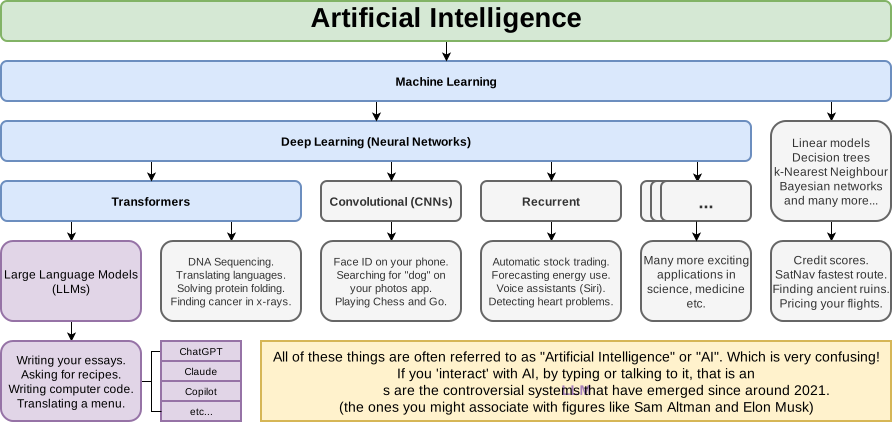
Artificial Intelligence (AI) is a field of Computer Science, which seeks to develop methods allowing computers to perform complex "intelligent" tasks. Tasks requiring "intelligence" are often considered to be those tasks which require a human, or are infeasible to us. As you can tell, this is extremely vague, and there's no generally accepted boundaries to what is or is not Artificial Intelligence.
Machine Learning is a more well-defined field under the umbrella of AI. Machine learning refers to technologies which attempt to perform these "intelligent" tasks, or solve complex problems, by enabling some process of "learning". Again the definition of learning is vague, but it often consists of repeatedly attempting a task and improving, or consuming large amounts of data in order to improve.
The world economy has been flooded with Machine Learning for decades. It helps airlines decide the price of your ticket, credit agencies calculate your credit score, geologists find mineral deposits and your car suggest the quickest route to go visit your Grandma.
Deep Learning is the next step down in the stack of vagueness. This finally refers to a specific technology, the Neural Network. Neural networks have been around for nearly half a century, but recently have seen massive increases in popularity. Neural networks learn by repeatedly consuming data to make predictions, comparing those predictions to true values, and using a measure of accuracy to improve the network.
This is similarly not a new technology. There are an innumerable variety of neural network architectures, some dating back to the 1950s. Architectures are varying ways to structure a neural network, each offering differing advantages and disadvantages, making them applicable to particular tasks. These tasks can include the facial recognition in your iPhone, automated trading on the stock market, speech recognition in your Alexa and famously beating expert humans in the games Chess and Go.
The Transformer, is one such architecture, introduced by a group of Google researchers all the way back in 2017. Originally developed for machine translation of large bodies of text, the Transformer is the architecture which gave rise of the LLM chat-bots, which are so controversial today.
That being said Transformers has also been harnessed to great effect in a myriad of other fields in science, medicine and computer science. They have assisted in solving the landmark protein folding problem, a massive achievement in science and medicine, as well as in many other very positive applications, like translating texts, detecting heart problems in ECGs and cancer from x-rays.
Large Language Models (LLMs) are what we are really discussing. As of writing (April 2026), the discourse about 'AI' is almost entirely focussed on LLMs. They exploded into the public consciousness in 2022, when OpenAI released ChatGPT, allowing the public to interact with an 'AI' which could talk for the first time. I will explain in the next section what LLMs are, what they can do. For now though,
It is crucial, therefore, that we understand what we are actually dealing with. The people running the AI companies are salesmen, not technological geniuses. The reason they spare you the details of their products is not to protect you from a headache. Rather, they are constantly obfuscating what these systems actually are, so that they can continue to pretend that they are on the cusp of inventing God.
We mustn't allow their vendors to benefit from the good-press the achievements of others rightly deserve, just so they can use it to convince investors to set fire to their money, motivated by FOMO and unquestioning belief in a 'guaranteed' dystopian future.
As I continue, I will separate the topic of current discussions (LLMs) from the rest of the 'AI' field (Machine Learning) and especially from other applications of modern neural networks (Deep Learning). I'll keep using these colour codes to make it clear what I'm referring to and never again use the acronym 'AI', except when referring to the utterings or actions of others.
